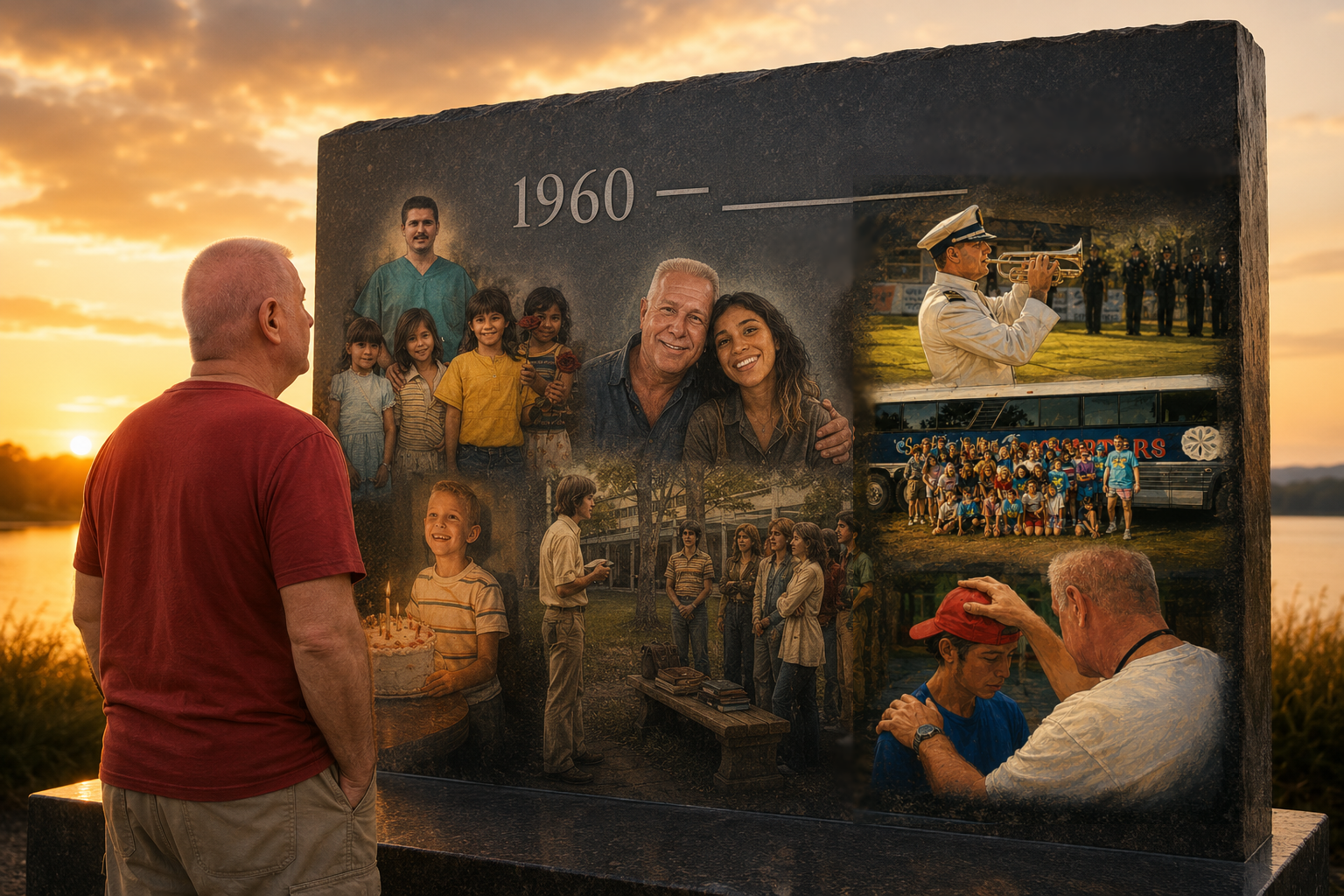
The dash is not filled with achievements. It is filled with people.
Deciding to Live Intentionally
Filling the Dash with Purpose
English and Spanish versions are included on this page.
The Dash
When I turned sixty, I became aware of the dash.
Not the dates.
Not the stone.
The dash.
Born — 1960
Died — ______
That small line between them.
I began to wonder what would fill it.
For most of my life, I moved fast—built things, fixed things, started things. I assumed impact required intention: big plans, mission statements, bold declarations.
But a few years ago, I ran into an old friend from my elementary school years.
“Do you remember walking me to school?” he asked.
I didn’t.
We had been boys. He had just arrived in America—unsure of the language, unsure of the rules, unsure of everything. I had simply walked beside him. Every morning. No speeches. No strategy. Just presence.
“That’s one of my strongest memories,” he said. “I didn’t feel alone.”
That sentence landed hard.
The Weight of Small Moments
I began to wonder how many lives I’ve touched without knowing it—how many small moments meant more than I ever realized.
And then the thought widened into something heavier.
I realized I’m making impressions on people all the time—small ones, quiet ones—without noticing. For good or for bad. A careless word. A sharp tone. A dismissive look. The kind of moment I might forget in ten minutes could live in someone else for ten years.
And that possibility horrified me.
Not just the good I might have done without knowing—but the harm. The bad impacts I may have left behind in other people’s lives without ever intending to.
In day-to-day living, I never expected to change someone’s life unintentionally. Sometimes I just showed up.
Now, there were other times when I did choose it. I stepped into roles where the whole point was to be used—to help, to guide, to carry someone through a hard moment. Youth ministry. Mission trips. Those long nights at summer camp when a kid hit a breaking point and melted down. Those moments mattered, and I knew they mattered, because I had chosen to be there for that purpose.
What shocked me was learning where the biggest moments usually lived.
Not in the sermons.
Not in the plans we made.
In the quiet stuff.
In the hallway conversation after everyone else left.
In sitting with someone when they couldn’t talk yet.
In a simple sentence at the right time.
In noticing someone who was slipping through the cracks.
Choosing Direction
And that was when I understood something:
Impact and intention are not the same thing.
You can stumble into impact.
But you cannot stumble into a meaningful life.
Impact may happen accidentally.
But intention must be chosen.
So I began asking myself different questions.
Does my life have meaning?
Am I making people’s lives lighter or heavier?
What will still matter after I’m gone?
I began asking:
“What can I do that outlives me?”
“What kind of man do I want to be remembered as?”
I realized living intentionally doesn’t mean scripting every conversation or forcing grand gestures.
It means structuring my life around direction instead of reaction.
Personality Becoming Purpose
I started small.
“You’ve never met a stranger,” someone close to me once said.
“You don’t know how to walk past people.”
It was true.
So I decided to use it.
What used to be personality would become purpose.
I began to see it as a kind of strength—my small superpower. The ability to make people feel seen. The ability to lower the temperature in a room. The ability to leave a smile where there wasn’t one before.
I carry humor like a pocketknife—not to cut anyone, but to open a smile. I’ll tell a tired cashier they look like a Monday-morning survivor, or ask a waiter for the “honest truth” about the menu. Sometimes it’s corny, but it’s always warm.
Intentional living isn’t about grand gestures.
It’s about refusing to let people feel invisible.
I believe you brighten a room either when you enter it or when you leave it.
I choose to brighten it when I enter.
Finishing Well
Now, when I think about that dash, I hope that when I’m gone, people won’t talk about what I built or fixed or accumulated.
I hope they’ll say:
“He made me feel seen.”
“He left me laughing.”
“He didn’t grow bitter.”
“He finished well.”
And most of all, when it’s over, I hope I will hear:
“Well done, my good and faithful servant.”
The View from Here: Reflections of an Imperfect Traveler
Decidir Vivir con Intención
Llenando el Guion con Propósito
El Guion
Cuando cumplí sesenta años, empecé a pensar en el guion.
No en las fechas.
No en la lápida.
En el guion.
Nacido — 1960
Fallecido — ______
Esa pequeña línea entre las dos fechas.
Comencé a preguntarme qué iba a llenar ese espacio.
Durante la mayor parte de mi vida me moví rápido: construí cosas, arreglé cosas, comencé cosas. Yo pensaba que el impacto requería intención: grandes planes, declaraciones de misión y palabras fuertes.
Pero hace algunos años me encontré con un viejo amigo de mis años de escuela primaria.
“¿Te acordás cuando caminabas conmigo a la escuela?”, me preguntó.
No me acordaba.
Éramos niños. Él acababa de llegar a Estados Unidos, inseguro del idioma, inseguro de las reglas, inseguro de todo. Yo simplemente caminaba a su lado. Cada mañana. Sin discursos. Sin estrategia. Solo presencia.
“Ese es uno de mis recuerdos más fuertes”, me dijo. “No me sentía solo.”
Esa frase me pegó fuerte.
El Peso de los Momentos Pequeños
Empecé a preguntarme cuántas vidas he tocado sin saberlo, cuántos momentos pequeños significaron más de lo que yo jamás imaginé.
Y luego ese pensamiento se volvió más pesado.
Me di cuenta de que estoy dejando impresiones en la gente todo el tiempo, impresiones pequeñas y silenciosas, sin darme cuenta. Para bien o para mal. Una palabra descuidada. Un tono fuerte. Una mirada que hace sentir a alguien menos. El tipo de momento que yo podría olvidar en diez minutos puede vivir en otra persona durante diez años.
Y esa posibilidad me asustó.
No solo el bien que pude haber hecho sin saberlo, sino también el daño. Los malos impactos que pude haber dejado en la vida de otras personas sin querer hacerlo.
En la vida diaria, nunca esperé cambiar la vida de alguien sin darme cuenta. A veces simplemente estuve presente.
Ahora, hubo otros momentos en los que sí lo escogí. Entré en roles donde el propósito era precisamente ser usado: ayudar, guiar y acompañar a alguien en un momento difícil. Ministerio juvenil. Viajes misioneros. Esas noches largas en campamentos de verano cuando un muchacho llegaba a su límite y se quebraba. Esos momentos importaban, y yo sabía que importaban, porque había escogido estar allí para eso.
Lo que me sorprendió fue descubrir dónde casi siempre vivían los momentos más grandes.
No en los sermones.
No en los planes que hicimos.
En las cosas calladas.
En la conversación del pasillo después de que todos se fueron.
En sentarse con alguien cuando todavía no podía hablar.
En una frase sencilla en el momento correcto.
En notar a alguien que se estaba quedando perdido entre la gente.
Escoger Dirección
Y fue entonces cuando entendí algo:
Impacto e intención no son lo mismo.
Uno puede tropezarse con el impacto.
Pero uno no se tropieza con una vida significativa.
El impacto puede pasar por accidente.
Pero la intención se tiene que escoger.
Así que empecé a hacerme preguntas diferentes.
¿Tiene sentido mi vida?
¿Estoy haciendo la vida de otros más liviana o más pesada?
¿Qué seguirá importando cuando yo ya no esté?
Empecé a preguntarme:
“¿Qué puedo hacer que siga viviendo después de mí?”
“¿Qué clase de hombre quiero que recuerden?”
Me di cuenta de que vivir con intención no significa escribir cada conversación de antemano ni forzar grandes gestos.
Significa ordenar mi vida alrededor de dirección en vez de reacción.
Cuando la Personalidad se Vuelve Propósito
Comencé con algo pequeño.
“Vos nunca has conocido a un extraño”, me dijo una vez alguien cercano.
“No sabés cómo pasar de largo frente a la gente.”
Era cierto.
Así que decidí usarlo.
Lo que antes era personalidad se convertiría en propósito.
Empecé a verlo como una clase de fuerza, mi pequeño superpoder. La habilidad de hacer que la gente se sienta vista. La habilidad de bajar la tensión en un cuarto. La habilidad de dejar una sonrisa donde antes no había una.
Llevo el humor como una navajita de bolsillo, no para cortar a nadie, sino para abrir una sonrisa. Le puedo decir a una cajera cansada que parece sobreviviente de un lunes por la mañana, o preguntarle a un mesero por la “verdad honesta” del menú. A veces es algo medio cursi, pero siempre va con cariño.
Vivir con intención no se trata de grandes gestos.
Se trata de negarse a dejar que la gente se sienta invisible.
Creo que uno ilumina un cuarto cuando entra o cuando sale.
Yo escojo iluminarlo cuando entro.
Terminar Bien
Ahora, cuando pienso en ese guion, espero que cuando me haya ido, la gente no hable de lo que construí, arreglé o acumulé.
Espero que digan:
“Me hizo sentir visto.”
“Me dejó riendo.”
“No se volvió amargado.”
“Terminó bien.”
Y sobre todo, cuando todo haya terminado, espero escuchar:
“Bien hecho, mi buen siervo fiel.”
La Vista Desde Aquí: Reflexiones de un Viajero Imperfecto