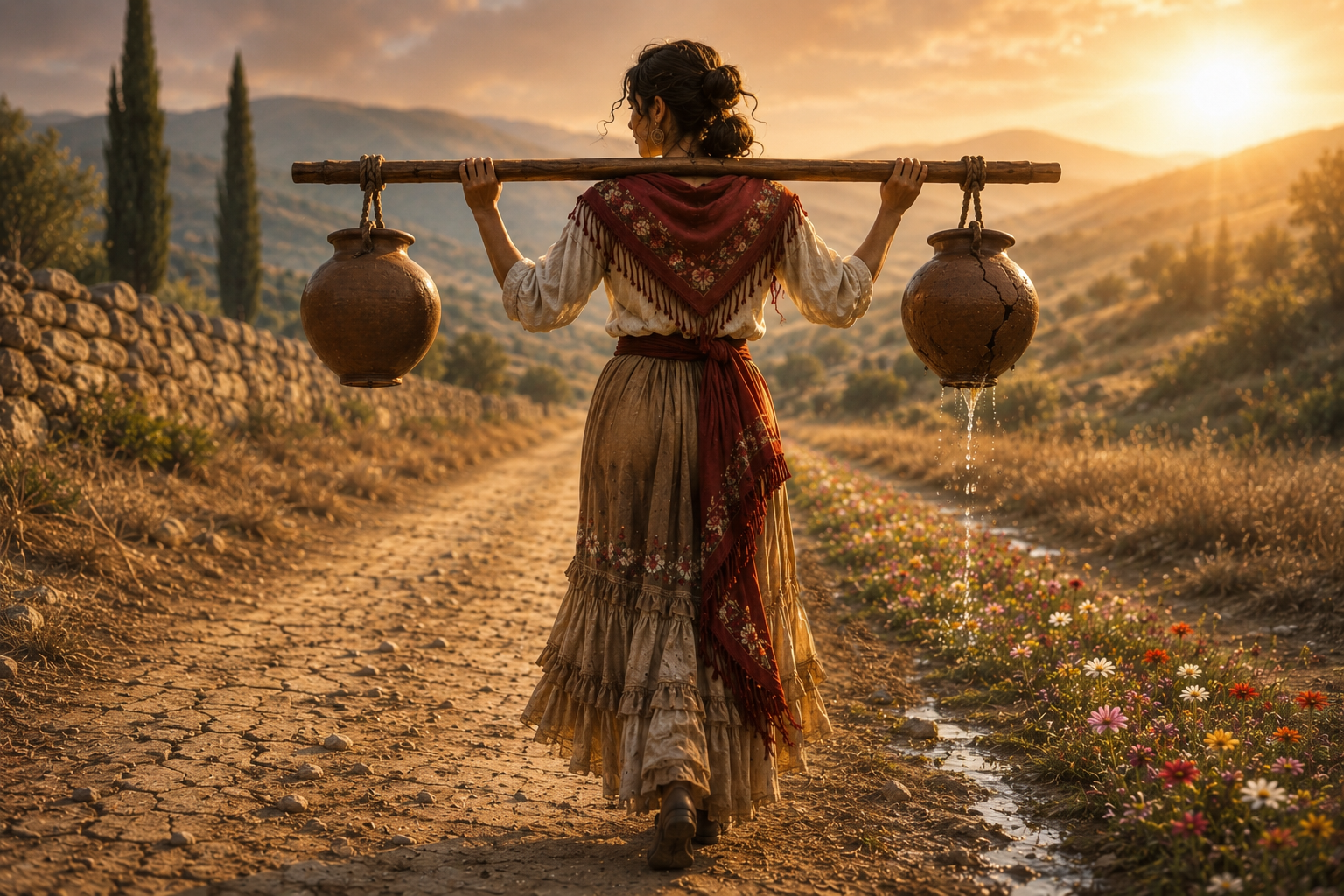
Even a cracked pot can be used by God.
The View from Here
Reflections of an Imperfect Traveler
English and Spanish versions are included on this page.
A Protector and a Fixer
Somewhere early in life, I learned that love could both comfort and wound. In my home, alcohol and abuse turned safe moments uncertain. I watched the air in a room change when tension rose. I saw people who loved each other still hurt each other deeply. That is a hard thing for a child to understand, so I did what children often do. I started watching.
That is where the protector in me was born. I became alert to faces, moods, and tones before words were spoken. I learned to read the room before the room admitted what was happening. I tried to shield my mother and brother. I tried to step between trouble and the people I loved, even when I was too small for the weight I carried.
No one gave me that job. There was no ceremony, no badge, and certainly no instruction manual. I simply took it because it felt like someone had to. I became a fixer too.
I smoothed things over, distracted, negotiated, and carried adult-sized concern on a child’s shoulders. That role does not retire easily. Even now, people bring me their broken situations — family trouble, church trouble, business trouble, life trouble — and something in me still reaches for the toolbox. Sometimes I help. Sometimes I overstep. Sometimes I fight battles that are not mine and try to repair people who do not want repairing.
Over time, I have learned that caring is not the same as carrying. Helping is not the same as rescuing. Love does not require me to stand in every storm with duct tape in one hand and a wrench in the other, although duct tape has saved more than one situation. The best protection is often quieter than that. Sometimes it is listening. Sometimes it is creating safety. Sometimes it is sitting beside someone in their pain without trying to explain it away.
That understanding is why church became so important to me — not as performance, not as polished spirituality, and not as a place for people to compete over who sounds the most holy. I mean church as sanctuary. A place where wounded people could breathe and grace could have the final word. I needed that refuge, so I spent years trying to help create it for others.
Learning the Hard Way
School was a struggle. I repeated third grade, and it felt like a public brand of failure. When you are a child, something like that does not feel like a small academic delay. It feels like a sign hung around your neck.
I remember my father telling my mother to have me tested “to see if I was stupid.” Those words landed heavy. I was not stupid. I was struggling. There is a difference, but it took me years to understand that and even longer to believe it.
I survived by becoming the class clown. Humor gave me a way to control rooms where I felt behind. If I could make people laugh, maybe they would not notice where I was struggling. Humor could get me out of trouble. Humor could get me into trouble. Sometimes it managed to do both before lunch, which takes either talent or poor judgment.
That was also when I found sarcasm. Sarcasm was quick, sharp, and useful. It could make people laugh before they realized someone had been cut. I learned how to use humor like a knife, not always because I wanted to hurt anyone, but because it helped me feel less helpless. It took me a long time to learn that a joke that protects the teller can still wound the listener. I have had to surrender the weaponized part of my humor while keeping the healing part. Humor has saved me more times than I can count, but sharp humor needs a careful hand. I have not always had one.
Because traditional learning did not come easily, I adapted. I learned by watching, doing, repeating, and connecting ideas to real life. I learned through people, pictures in my mind, observation, humor, and experience. Life itself became my classroom. Sometimes it was a hard classroom, but it taught well.
That struggle gave me empathy for people who do not learn, remember, speak, or heal the same way as everyone else. It also made me suspicious of titles, degrees, and religious credentials when people use them as thrones.
I respect honest learning. I respect earned responsibility. But I do not worship framed paper, important offices, or church language dressed up to sound deep.
I have known wise, gracious people with little formal education. I have known arrogant people with walls full of diplomas. A title can tell me what someone has done. It cannot tell me who they are.
Sanctuary
Church mattered because I needed a safe place. Not a perfect one. Churches are full of cracked people like me, and cracked people have a way of bringing their cracks with them. Sometimes they bring casseroles too, so it balances out a little.
But I needed sanctuary. I needed a place where hurting souls could be honest. A place where a person did not have to be impressive to matter. A place where God could meet broken people without everyone pretending they were not broken.
I served as a youth pastor for eleven years. Part-time on paper, full-time in my heart. Those years were filled with retreats, late nights, bad pizza, laughter, prayer, music, van rides, and moments of real breakthrough. They were also filled with deep pain — suicide, grief, broken families, and young people carrying more than they knew how to name.
Those years taught me that ministry is not mostly about platforms or programs. Sometimes ministry is staying present when the room is heavy and words fall short. Sometimes it is listening. Sometimes it is crying with people. Sometimes it is saying very little because the situation is too painful for easy answers.
God showed up in the chaos more often than in the polished plans. Camp Lee and Ichthus Youth Retreat mattered deeply to me because they became sanctuary in motion. There was music, laughter, exhaustion, prayer, confusion, grace, and teenagers discovering that faith could be real without being stiff and lifeless.
There were probably moments when everything looked organized from the outside. That was an illusion.
Youth ministry has a way of reminding you that control is mostly theoretical. You can plan the schedule, print the forms, line up the speakers, and still end up solving some crisis involving missing shoes, hurt feelings, van logistics, and somebody who forgot every instruction they were given in the last ten minutes. And somehow, God still shows up.
I made plenty of mistakes. I pushed too hard sometimes. I carried too much sometimes. I tried to fix things that needed more prayer and less Dale. But I hope some young people found breathing room. I hope they knew they were seen. I hope they found a little safety, a little laughter, and a little grace.
Because that is what I was looking for too.
When the Road Became Real
The road became real for me in 1988, on my first mission trip to Costa Rica. I went with a dental team. I was not the dentist, and I was not the preacher. I mostly held lights, filmed video, entertained kids, and stayed in the background. In other words, highly specialized mission work.
That is where I met Shirleny. She was eight years old. After the dentist fixed one of her front teeth, she smiled the kind of smile that changes the whole room. Her face lit up, and all her friends wanted to see.
The next day, I asked how her mother liked her new tooth. Her face fell. I did not know she had no mother. I did not know she was an orphan. I had asked a simple question and walked straight into a deep wound.
Later, I walked her to her grandmother’s home and saw where they lived. It was a small two-room place with a tin roof and a dirt floor. The walls had spaces where the boards did not meet. You could see through places in the house.
That night, the complaints we had been making about our hotel suddenly felt embarrassingly small. I woke up around two in the morning crying harder than I had ever cried before. It was not self-pity. That was what made it different. My heart was grieving for someone else.
God used that little girl to break something open in me. I saw my own selfishness more clearly than I wanted to, but I also felt God softening something in me.
Before we left, I gave Shirleny five dollars. She took my hand and led me across the road to a little store, where she used that money to buy me a Coke. I had so much, and she had so little, and she gave back to me. At that moment, I was the one with less. She was the teacher.
That trip changed how I saw poverty, generosity, missions, and myself. I saw Jesus in Shirleny’s smile, and I have never been able to completely unsee Him there. It was not just a trip. It was a turning point.
Finding Peace
For most of my life, I knew how to keep moving. I knew how to work. I knew how to fix. I knew how to show up. I knew how to be useful. What I did not know was how to rest. A fixer can run on being needed for a long time, but it is exhausting. Being useful is not the same as being loved. Being needed is not the same as being known. Being the fixer is not the same as being safe.
Later in the journey, God brought Fanny into my life. With her, I found something I did not fully know I needed: peace. Not a trouble-free life. There are still distances, paperwork, delays, frustrations, hard days, and the occasional urge to fuss at an entire immigration system. But underneath all that, there is peace.
Fanny’s presence lets my soul unclench. She does not demand performance. She brings laughter, steadiness, trust, and emotional rest. For a man who learned early to watch every room, it is no small thing to be with someone who feels safe. For a lifelong protector and fixer, it is healing to be loved without having to earn it by solving everything.
I still try to fix things. That part of me did not disappear. I am still learning where helping ends and carrying begins. I am still learning that not every burden has my name written on it, even if someone hands it to me with great confidence.
But with Fanny, I have learned something about resting. To laugh. To trust. To breathe. To be a man, not just a toolbox with opinions. And at this stage of the journey, peace is not a small thing.
Still on the Road
I am not finished yet. I am still an imperfect traveler. The boy who watched the room and carried too much still shows up in me. He shows up when I overthink. He shows up when I over-fix. He shows up when I use humor to deflect pain. He shows up when I replay a moment and wonder if I could have handled it better. But God has been patient with that boy. God has been patient with the man too.
Looking back, I see His hand in places I once missed: in the hard rooms of my childhood, in the classrooms where I felt behind, in the sanctuary of church, in Shirleny’s smile, and in the quiet peace I have found with Fanny. I see Him in the laughter. I see Him in the losses. I see Him in the mistakes. I see Him in the grace that showed up anyway.
The view from here is clearer than it used to be, but it is still filtered through a cracked vessel. My life is not a trophy case, a résumé, or a finished monument. It is a long road carried more by grace than by strength.
I keep walking — still learning, still laughing when I can, still grieving when I must. I know now that love does not have to be dangerous. Struggle does not mean failure. Humor can heal when it is not being used to cut. Titles matter far less than fruit. Grace meets us while we are still becoming.
I am not the man I was. I am not yet the man I hope to be. And I am not traveling alone.
La Vista Desde Aquí
Reflexiones de un Viajero Imperfecto
Un Protector y un Arreglador
Desde muy temprano en la vida, aprendí que el amor podía consolar y también herir. En mi casa, el alcohol y el abuso convertían los momentos seguros en momentos inciertos. Yo veía cómo cambiaba el ambiente de un cuarto cuando subía la tensión. Vi a personas que se amaban hacerse daño profundamente. Eso es algo difícil de entender para un niño, así que hice lo que muchos niños hacen. Empecé a observar.
Ahí nació el protector en mí. Me volví atento a los rostros, los estados de ánimo y los tonos de voz antes de que se dijeran las palabras. Aprendí a leer el ambiente antes de que el ambiente admitiera lo que estaba pasando. Traté de proteger a mi madre y a mi hermano. Traté de ponerme entre el problema y las personas que amaba, aun cuando era demasiado pequeño para el peso que estaba cargando.
Nadie me dio ese trabajo. No hubo ceremonia, ni placa, ni mucho menos manual de instrucciones. Simplemente lo tomé porque sentía que alguien tenía que hacerlo. También me convertí en un arreglador.
Trataba de suavizar las situaciones, distraer, negociar y cargar preocupaciones de adulto sobre hombros de niño. Ese papel no se jubila fácilmente. Aun hoy, la gente me trae sus situaciones rotas — problemas familiares, problemas de iglesia, problemas de negocios, problemas de vida — y algo dentro de mí todavía busca la caja de herramientas. A veces ayudo. A veces me meto de más. A veces peleo batallas que no son mías y trato de reparar a personas que no quieren ser reparadas.
Con el tiempo, he aprendido que preocuparse no es lo mismo que cargar. Ayudar no es lo mismo que rescatar. Amar no exige que me pare en medio de cada tormenta con cinta adhesiva en una mano y una llave inglesa en la otra, aunque la cinta adhesiva ha salvado más de una situación. La mejor protección muchas veces es más callada que eso. A veces es escuchar. A veces es crear seguridad. A veces es sentarse al lado de alguien en su dolor sin tratar de explicarlo.
Esa comprensión es una de las razones por las que la iglesia llegó a ser tan importante para mí — no como actuación, ni como espiritualidad pulida, ni como un lugar donde la gente compite para ver quién suena más santo. Me refiero a la iglesia como santuario. Un lugar donde las personas heridas pueden respirar y donde la gracia puede tener la última palabra. Yo necesitaba ese refugio, así que pasé años tratando de ayudar a crearlo para otros.
Aprendiendo por el Camino Difícil
La escuela fue una lucha. Repetí tercer grado, y eso se sintió como una marca pública de fracaso. Cuando uno es niño, algo así no se siente como un pequeño retraso académico. Se siente como un letrero colgado del cuello.
Recuerdo que mi padre le dijo a mi madre que me llevara a examinar “para ver si yo era estúpido.” Esas palabras pesaron mucho. Yo no era estúpido. Estaba luchando. Hay una diferencia, pero me tomó años entenderla y todavía más tiempo creerla.
Sobreviví convirtiéndome en el payaso de la clase. El humor me daba una manera de controlar los salones donde me sentía atrasado. Si podía hacer reír a la gente, tal vez no notarían dónde estaba luchando. El humor podía sacarme de problemas. El humor podía meterme en problemas. A veces lograba hacer las dos cosas antes del almuerzo, lo cual requiere talento o mal juicio.
Ahí también encontré el sarcasmo. El sarcasmo era rápido, filoso y útil. Podía hacer reír a la gente antes de que se dieran cuenta de que alguien había sido cortado. Aprendí a usar el humor como cuchillo, no siempre porque quisiera herir a alguien, sino porque me ayudaba a sentirme menos indefenso. Me tomó mucho tiempo aprender que una broma que protege al que la dice todavía puede herir al que la recibe. He tenido que rendirle a Dios la parte armada de mi humor, mientras conservo la parte que sana. El humor me ha salvado más veces de las que puedo contar, pero el humor filoso necesita una mano cuidadosa. No siempre la he tenido.
Como el aprendizaje tradicional no me venía fácilmente, me adapté. Aprendí mirando, haciendo, repitiendo y conectando ideas con la vida real. Aprendí por medio de personas, imágenes en mi mente, observación, humor y experiencia. La vida misma se convirtió en mi salón de clases. A veces fue un salón duro, pero enseñó bien.
Esa lucha me dio empatía por las personas que no aprenden, recuerdan, hablan o sanan igual que los demás. También me hizo desconfiar de los títulos, grados y credenciales religiosas cuando la gente los usa como tronos.
Respeto el aprendizaje honesto. Respeto la responsabilidad ganada. Pero no adoro papeles enmarcados, cargos importantes ni lenguaje de iglesia vestido para sonar profundo.
He conocido personas sabias y llenas de gracia con poca educación formal. He conocido personas arrogantes con paredes llenas de diplomas. Un título puede decirme lo que alguien ha hecho. No puede decirme quién es.
Santuario
La iglesia importó porque necesitaba un lugar seguro. No uno perfecto. Las iglesias están llenas de personas agrietadas como yo, y las personas agrietadas suelen traer sus grietas con ellas. A veces también traen comida, así que eso ayuda un poco.
Pero yo necesitaba santuario. Necesitaba un lugar donde las almas heridas pudieran ser honestas. Un lugar donde una persona no tuviera que ser impresionante para importar. Un lugar donde Dios pudiera encontrarse con personas quebrantadas sin que todos fingieran que no estaban quebrantados.
Serví como pastor de jóvenes durante once años. Medio tiempo en papel, tiempo completo en el corazón. Esos años estuvieron llenos de retiros, noches largas, mala pizza, risas, oración, música, viajes en van y momentos de verdadero avance. También estuvieron llenos de dolor profundo — suicidio, duelo, familias rotas y jóvenes cargando más de lo que sabían nombrar.
Esos años me enseñaron que el ministerio no se trata principalmente de plataformas o programas. A veces el ministerio es quedarse presente cuando el cuarto está pesado y las palabras no alcanzan. A veces es escuchar. A veces es llorar con las personas. A veces es decir muy poco porque la situación es demasiado dolorosa para respuestas fáciles.
Dios apareció en el caos más a menudo que en los planes pulidos. Camp Lee y el Ichthus Youth Retreat fueron muy importantes para mí porque se convirtieron en santuario en movimiento. Había música, risa, cansancio, oración, confusión, gracia y adolescentes descubriendo que la fe podía ser real sin ser rígida ni sin vida.
Probablemente hubo momentos en que todo parecía organizado desde afuera. Eso era una ilusión.
El ministerio juvenil tiene una manera de recordarte que el control es mayormente teórico. Puedes planear el horario, imprimir los formularios, coordinar a los oradores, y aun así terminar resolviendo alguna crisis con zapatos perdidos, sentimientos heridos, logística de vans y alguien que olvidó cada instrucción que recibió en los últimos diez minutos. Y de alguna manera, Dios todavía aparece.
Cometí muchos errores. A veces presioné demasiado. A veces cargué demasiado. Traté de arreglar cosas que necesitaban más oración y menos Dale. Pero espero que algunos jóvenes hayan encontrado espacio para respirar. Espero que hayan sabido que eran vistos. Espero que hayan encontrado un poco de seguridad, un poco de risa y un poco de gracia.
Porque eso también era lo que yo estaba buscando.
Cuando el Camino se Volvió Real
El camino se volvió real para mí en 1988, en mi primer viaje misionero a Costa Rica. Fui con un equipo dental. Yo no era el dentista, y no era el predicador. Mayormente sostenía luces, grababa video, entretenía niños y me mantenía en segundo plano. En otras palabras, trabajo misionero altamente especializado.
Ahí conocí a Shirleny. Tenía ocho años. Después de que el dentista le arregló uno de sus dientes frontales, sonrió con una sonrisa que cambia todo un cuarto. Su rostro se iluminó, y todas sus amigas querían ver.
Al día siguiente, le pregunté cómo le había gustado a su mamá su diente nuevo. Su rostro se cayó. Yo no sabía que ella no tenía madre. No sabía que era huérfana. Hice una pregunta sencilla y caminé directo hacia una herida profunda.
Más tarde, la acompañé a la casa de su abuela y vi dónde vivían. Era una casita de dos cuartos con techo de lámina y piso de tierra. Las paredes tenían espacios donde las tablas no se juntaban. Se podía ver hacia adentro por algunas partes de la casa.
Esa noche, las quejas que habíamos estado haciendo sobre nuestro hotel de pronto se sintieron vergonzosamente pequeñas. Me desperté como a las dos de la mañana llorando más fuerte de lo que jamás había llorado. No era lástima por mí mismo. Eso era lo diferente. Mi corazón estaba sufriendo por alguien más.
Dios usó a esa niña para abrir algo en mí. Vi mi propio egoísmo con más claridad de la que quería, pero también sentí que Dios estaba suavizando algo dentro de mí.
Antes de irnos, le di a Shirleny cinco dólares. Ella tomó mi mano y me llevó al otro lado de la calle a una tiendita, donde usó ese dinero para comprarme una Coca-Cola. Yo tenía tanto, y ella tenía tan poco, y aun así me dio de vuelta. En ese momento, yo era el que tenía menos. Ella era la maestra.
Ese viaje cambió la manera en que veía la pobreza, la generosidad, las misiones y a mí mismo. Vi a Jesús en la sonrisa de Shirleny, y nunca he podido dejar de verlo allí por completo. No fue solo un viaje. Fue un punto de cambio.
Encontrando Paz
Durante la mayor parte de mi vida, supe cómo seguir moviéndome. Sabía trabajar. Sabía arreglar. Sabía presentarme cuando me necesitaban. Sabía ser útil. Lo que no sabía era cómo descansar. Un arreglador puede vivir de sentirse necesario por mucho tiempo, pero eso agota. Ser útil no es lo mismo que ser amado. Ser necesitado no es lo mismo que ser conocido. Ser el arreglador no es lo mismo que estar seguro.
Más adelante en el camino, Dios trajo a Fanny a mi vida. Con ella encontré algo que no sabía completamente que necesitaba: paz. No una vida sin problemas. Todavía hay distancias, papeles, retrasos, frustraciones, días difíciles y el deseo ocasional de reclamarle a todo un sistema de inmigración. Pero debajo de todo eso, hay paz.
La presencia de Fanny permite que mi alma se suelte. Ella no exige actuación. Trae risa, firmeza, confianza y descanso emocional. Para un hombre que aprendió temprano a vigilar cada cuarto, no es poca cosa estar con alguien que se siente seguro. Para un protector y arreglador de toda la vida, es sanador ser amado sin tener que ganárselo resolviendo todo.
Todavía trato de arreglar cosas. Esa parte de mí no desapareció. Todavía estoy aprendiendo dónde termina ayudar y dónde empieza cargar. Todavía estoy aprendiendo que no toda carga tiene mi nombre escrito, aunque alguien me la entregue con mucha confianza.
Pero con Fanny, he aprendido algo sobre descansar. Reír. Confiar. Respirar. Ser un hombre, no solo una caja de herramientas con opiniones. Y en esta etapa del camino, la paz no es poca cosa.
Todavía en el Camino
No he terminado todavía. Sigo siendo un viajero imperfecto. El niño que observaba el cuarto y cargaba demasiado todavía aparece en mí. Aparece cuando pienso demasiado. Aparece cuando trato de arreglar demasiado. Aparece cuando uso el humor para desviar el dolor. Aparece cuando repaso un momento y me pregunto si pude haberlo manejado mejor. Pero Dios ha sido paciente con ese niño. Dios también ha sido paciente con el hombre.
Al mirar atrás, veo Su mano en lugares que antes no veía: en los cuartos duros de mi infancia, en los salones donde me sentía atrasado, en el santuario de la iglesia, en la sonrisa de Shirleny y en la paz tranquila que he encontrado con Fanny. Lo veo en la risa. Lo veo en las pérdidas. Lo veo en los errores. Lo veo en la gracia que apareció de todos modos.
La vista desde aquí es más clara de lo que era antes, pero todavía está filtrada a través de una vasija agrietada. Mi vida no es una vitrina de trofeos, un currículum ni un monumento terminado. Es un largo camino llevado más por gracia que por fuerza.
Sigo caminando — todavía aprendiendo, todavía riendo cuando puedo, todavía llorando cuando debo. Ahora sé que el amor no tiene que ser peligroso. La lucha no significa fracaso. El humor puede sanar cuando no se usa para cortar. Los títulos importan mucho menos que el fruto. La gracia nos encuentra mientras todavía estamos llegando a ser.
No soy el hombre que fui. Todavía no soy el hombre que espero ser. Y no estoy viajando solo.