
BP-007: A Tale of Two Women
The Stone, the Cross, and the Extraordinary Promise of Redemption
Berean Paper Status
Division:
Christian Theology and Comparative Religion
Classification:
Scriptural and Theological Analysis
Primary concern:
Redemption and right standing with God
Abstract
Two women. Two encounters. Two radically different outcomes. At the center of this inquiry stands a question that reaches beyond either woman: when we sin, on what basis can we stand before God?
This paper contrasts the woman caught in adultery in John with the woman of Ghamid in Sahih Muslim, using the encounter at Jacob’s well to introduce the Christian promise of living water. Its principal concern is not punishment, but redemption: the price paid, the righteousness granted and the relationship restored.
1. The Woman at the Well
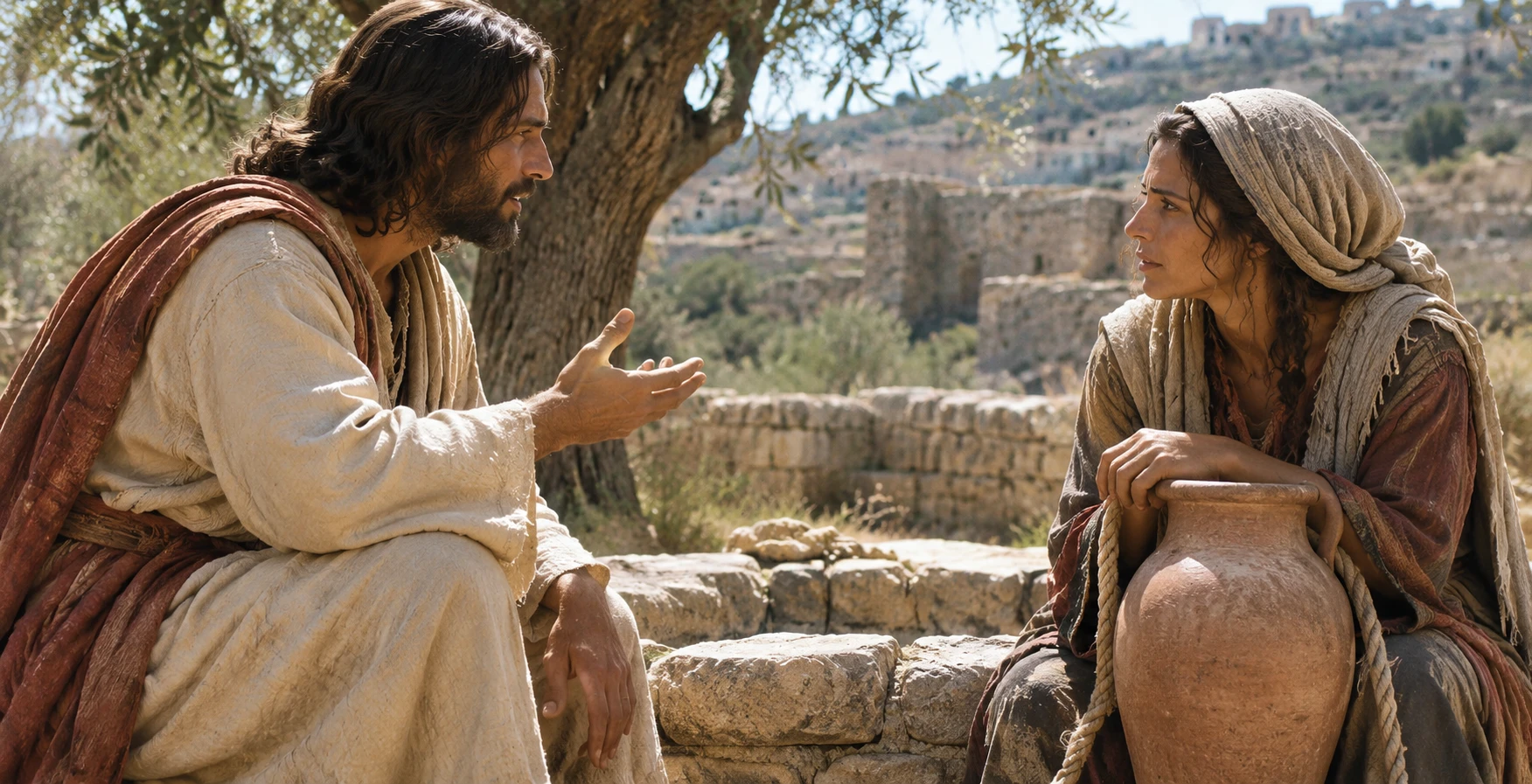
At about the sixth hour, conventionally understood as noon, Jesus spoke with a Samaritan woman at Jacob’s well. He revealed that she had had five husbands and that her present companion was not her husband. The passage does not explain why her marriages ended or identify her as a prostitute. [1]
“But whosoever drinketh of the water that I shall give him shall never thirst”
John 4:14 (KJV)
Jesus knew her history and still offered her living water. She returned to her community and spoke of Him. Her past did not disqualify her from hearing His invitation.
In the Christian understanding, this was God incarnate meeting a woman where she was. She did not have to put her life in order before He offered her living water. This encounter introduces the two accounts that follow.
2. The Woman Before Jesus
In another encounter, a woman accused of adultery was brought before Jesus. Her accusers invoked the law of Moses and sought to test Him. [2]
Leviticus 20:10 and Deuteronomy 22:22 prescribe death for both parties to adultery. Yet the man is absent from this account. Jesus declared that He came not to destroy the Law or the prophets, but to fulfill them (Matthew 5:17). The Christian reading of this encounter must be understood in light of that fulfillment. [3]
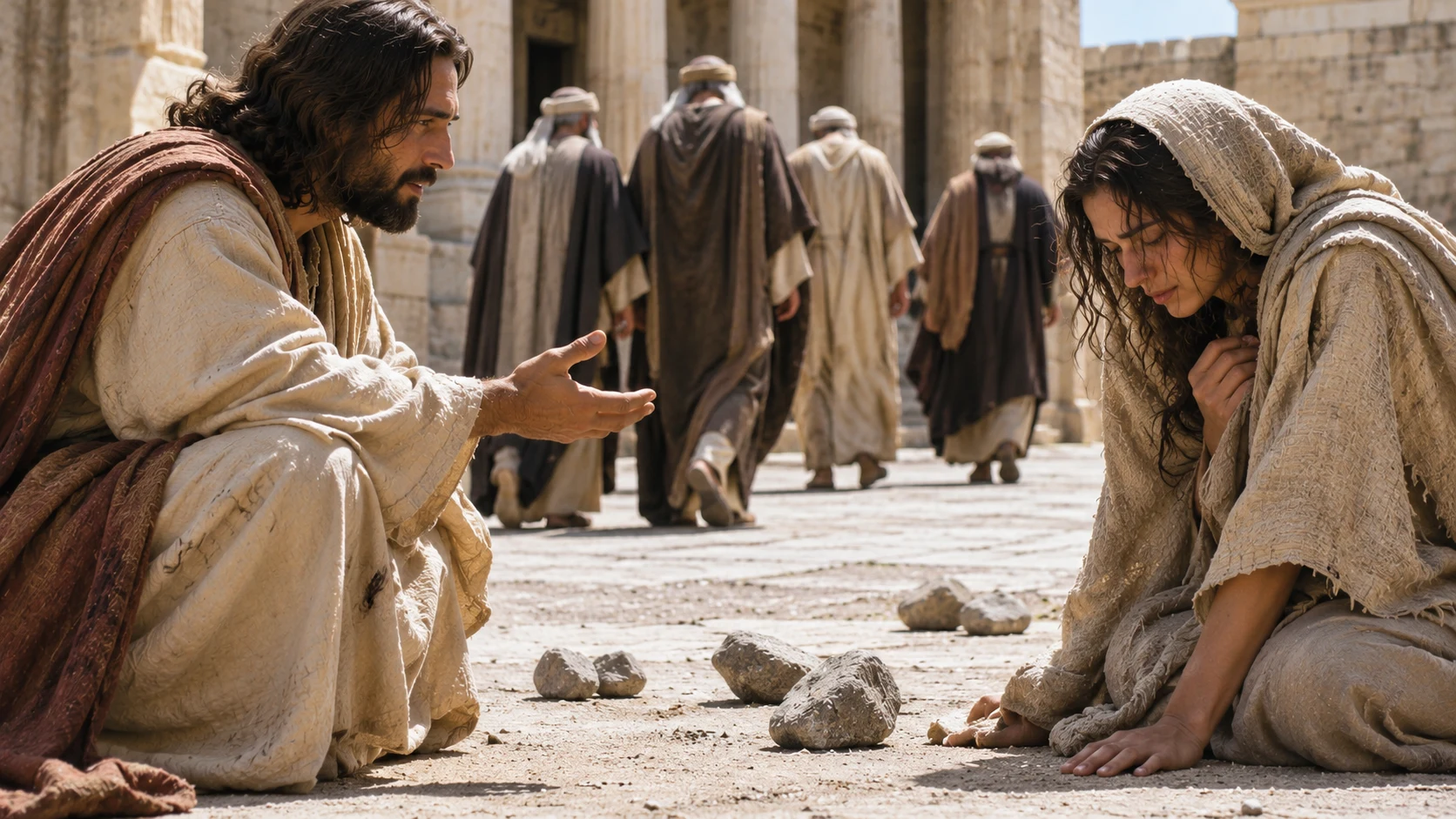
“He that is without sin among you, let him first cast a stone at her.”
John 8:7 (KJV)
Her accusers departed. Jesus did not declare adultery acceptable. He called her to a changed life.
“Neither do I condemn thee: go, and sin no more.”
John 8:11 (KJV)
The woman walked away alive. The one Christians confess to be without sin did not cast a stone.
3. The Woman Before Muhammad
Sahih Muslim, a major Sunni hadith collection, preserves accounts of a woman from Ghamid who voluntarily confessed to adultery while pregnant. Unlike the woman brought before Jesus by her accusers, she came of her own accord. Muhammad initially directed her toward repentance and turned her away; she persisted. [4]
In the parallel account, punishment was deferred until her child was weaned. Muhammad entrusted the child to another person and ordered the woman to be stoned to death. He subsequently praised her repentance and prayed over her. [5]
Her repentance was acknowledged, yet the earthly sentence was carried out. The same hadith accounts also relate the execution of a man for adultery. This is not a punishment presented as exclusive to women.
4. Justice, Mercy and the Price of Sin
Islam does teach divine mercy and forgiveness: Quran 39:53–54 calls sinners to repentance and hope in Allah’s mercy. Quran 24:2 prescribes lashes for unlawful sexual intercourse; classical stoning rulings draw on hadith and jurisprudence. [6] [7]
It would be inaccurate to claim that Muslims must die to receive forgiveness, or that the execution proves God rejected this woman. The distinction is between earthly punishment and the means of reconciliation with God. Islam does not accept the Christian doctrine of Christ’s sacrificial death as the means of salvation.
Could It Happen Today?
Imagine a woman who has committed adultery entering a Christian church today. She approaches the altar, kneels and asks God for forgiveness. Should she expect a gathering of people outside the church, waiting to carry out a sentence of death? Such an act would stand against the example of Christ and the Christian understanding of redemption.
Now consider a woman in circumstances similar to those of the woman of Ghamid. Could her fate depend upon where she lives and the religious laws under which she is governed?
In Iran, adultery remains punishable by death under specified circumstances. A 2026 British Home Office report documents death sentences imposed in 2022 and 2023, while noting that prosecutions are rare and information about enforcement is limited. [8] This does not describe every Muslim community or legal system. It does establish that the question remains relevant today.
One woman walked away. The other did not.
But the Christian promise extends far beyond being permitted to walk away.
“For all have sinned, and come short of the glory of God;”
Romans 3:23 (KJV)
The Christian question is universal. If none of us is righteous on our own merits, how can any of us stand before a holy God? [9]
5. Beyond Forgiveness: The Weight of Redemption
We often reduce redemption to forgiveness. But what Christ accomplished reaches far beyond the pardon of an offense.
Forgiveness
The offense is pardoned.
Redemption
The price of liberation has been paid.
Justification
We are declared righteous before God.
Reconciliation
Our relationship with God is restored.
Imagine standing before God, fully aware of every failure, every compromise, every hidden thought. Now imagine not merely being pardoned, but being declared righteous in His sight.
Not tolerated. Not reluctantly accepted. Not perpetually indebted.
“For he hath made him to be sin for us, who knew no sin; that we might be made the righteousness of God in him.”
2 Corinthians 5:21 (KJV)
Through Christ, we may stand upright in the presence of the very God against whom we have sinned. Not because we have earned that standing, but because Christ has secured it for us. [10]
For those who struggle with the grace of God, this is overwhelming. We understand consequences. We understand debt. What we struggle to comprehend is a God who willingly bears the cost of our redemption.
6. The Stone and the Cross

The one who did not condemn the woman would ultimately give His own life. In Christian theology, the cross is not a denial of justice but the means by which God reconciles sinners to Himself. [11]
Grace does not make sin acceptable or remove every earthly consequence. It changes the basis of our standing before God. We do not approach Him claiming innocence; we approach trusting in Christ.
“Let us therefore come boldly unto the throne of grace, that we may obtain mercy, and find grace to help in time of need.”
Hebrews 4:16 (KJV)
Boldly. Consider the magnitude of that invitation. The believer need not approach God as someone forever attempting to pay a debt already paid. [12]
The One who offered living water would Himself cry out from the cross, “I thirst.” [13]
And before surrendering His life, He would declare:
“It is finished.”
John 19:30 (KJV)
What was finished? Not merely the forgiveness of an offense, but the redemptive work through which sinful humanity could be reconciled to God.
The Christian who kneels before God seeking forgiveness does not come to pay the price of redemption. That price has already been paid. The extraordinary promise of the cross is that we may rise, not merely forgiven, but justified, reconciled and made righteous in Christ.
Our redemption was accomplished not through the shedding of our own blood, but through His.
There is power in the blood.
7. Questions for the Berean
Two women stood before two men central to their respective faiths. Both encounters concerned adultery, yet their earthly outcomes were profoundly different. Examine the accounts and consider:
- What accounts for the different outcomes of the two encounters, including the different circumstances in which the women appeared?
- What is the significance of Jesus withholding condemnation when the Law prescribed death?
- How do the Quran’s teachings on mercy and the hadith’s account of the woman’s execution relate to one another?
- Could a woman in similar circumstances face a death sentence today? How might her geographical location and governing law affect her fate?
- What does the Christian claim that Jesus is God incarnate contribute to our understanding of the two encounters?
- Beyond forgiveness, how does each faith understand right standing before God? Is there an equivalent to the Christian understanding of redemption and justification through Christ?
- Do the original sources support the distinctions presented here, including if the disputed passage in John is set aside?
One woman walked away. The other did not.
What is the difference between being forgiven and being redeemed?
Read. Reason. Search. Test.
8. Notes and References
- John 4:1-42 (KJV). Open source ↩
- John 7:53-8:11 (KJV). Open source ↩
- Leviticus 20:10; Deuteronomy 22:22; Matthew 5:17 (KJV). Open source ↩
- Sahih Muslim 1695a. Open source ↩
- Sahih Muslim 1695b. Open source ↩
- Quran 39:53–54. Open source ↩
- Quran 24:2. Open source ↩
- UK Home Office, Country policy and information note: Zina (sex outside of marriage and adultery), Iran, April 2026, updated 21 October 2026, sections 3.1.5–3.1.9. Open source ↩
- Romans 3:23-26 (KJV). Open source ↩
- 2 Corinthians 5:17-21; Romans 5:1-2 (KJV). Open source ↩
- Romans 5:6-11; Ephesians 1:7; 1 Peter 2:24 (KJV). Open source ↩
- Hebrews 4:14-16; Romans 8:1 (KJV). Open source ↩
- John 4:10–14; John 19:28–30 (KJV). Open source ↩
The Berean Declaration
We do not claim to be without convictions, nor do we apologize for having them. We claim no exemption from scrutiny.
Examine our sources. Challenge our reasoning. Test our conclusions against Scripture.
If we are wrong, show us where. If our conclusions withstand examination, consider what that means.
That is the spirit of the Berean.
We are inviting examination, not withholding conviction.
Read. Reason. Search. Test.