
BP-003: When Was “The Beginning”?
Genesis 1, the age of the universe, and the best non-answer answer I have ever heard.
Berean Paper Status
Division: Faith, Creation, and Reason Unit
Classification: Scriptural and Theological Reflection
Primary concern: Whether Genesis 1 actually tells us when “the beginning” occurred.
BP-003 is intentionally narrower than the preceding Berean Papers. Its argument depends less on constructing a new interpretation than on observing the limits of the text: Genesis answers some questions emphatically while leaving others unstated.
Abstract
I have never spent much time struggling over the mechanics of creation. I was not there. If science says there was a Big Bang, fine. My question has always been pretty simple: Who made the bang? Where did it come from?
Then I heard a discussion of Genesis 1 that approached the subject in a way I had somehow never seriously considered. It was not primarily an argument for a young earth or an old earth. It did not begin by trying to force science into the Bible or the Bible into science. It began with a simpler question:
What does the Book actually say?
Genesis begins, “In the beginning God created the heaven and the earth.” When was “the beginning”? The verse does not say. The next verse describes the condition of the earth, but it does not tell us how much time—if any—separates the opening declaration from that description. That observation does not prove an old universe. It does not prove a young one. It simply refuses to make Genesis answer a question Genesis 1:1 does not explicitly answer.
That may be the best non-answer answer I have ever heard.
Central proposition.
Genesis 1:1 tells us that there was a beginning and identifies the Creator. It does not tell us when that beginning occurred.
1. What This Paper Claims—and What It Does Not
The text establishes
- Genesis opens by identifying God as the Creator of “the heaven and the earth.”[1]
- Genesis 1:1 uses the phrase “in the beginning” without attaching a numerical date, age, or duration to it.
- Genesis 1:2 turns attention specifically to the condition of the earth.[2]
- The chapter then presents an ordered sequence of divine speech and creative acts.[3]
- Serious Christian interpreters disagree over how the opening creation and the six creation days relate chronologically.[4]
The text does not establish by itself
- That the universe is billions of years old.
- That the universe is only thousands of years old.
- That a long chronological gap must exist between Genesis 1:1 and 1:2.
- That the six creation days must be figurative.
- That the six creation days cannot be ordinary days.
- That any modern scientific model is secretly encoded in Genesis.
The argument is deliberately narrow: before deciding what Genesis means about chronology, we should first distinguish what the text explicitly states from what an interpreter must infer.
2. The Question That Stopped Me
Creation has never been one of the theological questions that kept me awake at night. I was not present, and I have never felt a need to pretend that I can reconstruct every mechanism God used. However it happened, I am here. Something happened.
That is why the CrossExamined discussion was so arresting. Frank Turek did not begin by announcing a new theory. He simply walked through the first two verses and asked a question so obvious that I had somehow never heard it framed that way:
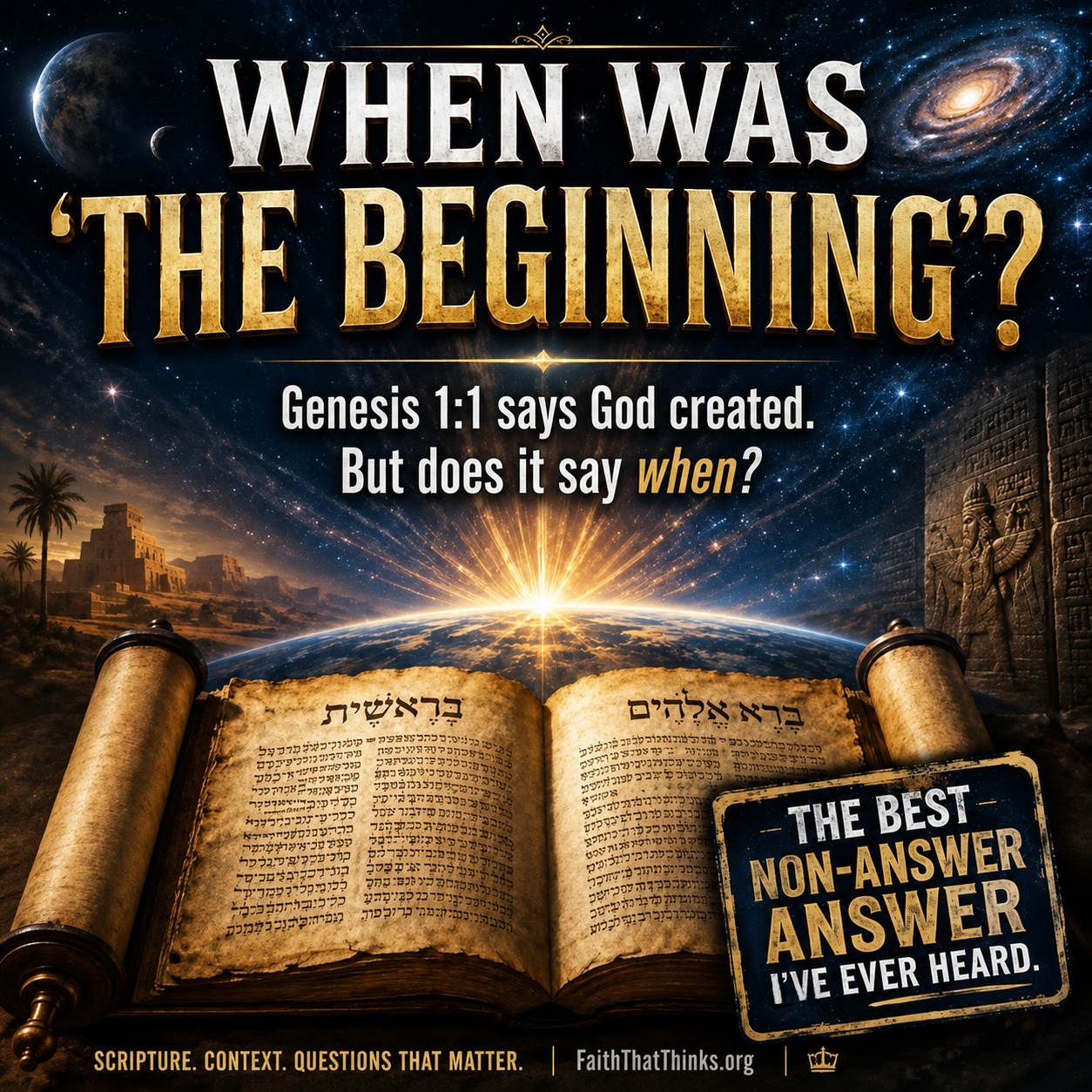
“In the beginning God created the heaven and the earth.”
When was the beginning?
The text does not say.
That is not an evasion. It is an observation.
We may have excellent reasons from theology, philosophy, science, tradition, Hebrew grammar, or the rest of Scripture for preferring one creation model over another. But those arguments have to be made. They cannot simply be smuggled into the words “in the beginning.”
3. What Genesis 1:1 Actually Gives Us
“In the beginning God created the heaven and the earth.” — Genesis 1:1, KJV[1]
The sentence is remarkably compact. It gives us a beginning. It gives us a Creator. It gives us the comprehensive phrase “heaven and earth.” What it does not give us is a calendar.
| Question | What Genesis 1:1 says | What Genesis 1:1 does not specify |
|---|---|---|
| Was there a beginning? | Yes. The verse opens “In the beginning.” | It does not assign that beginning a date. |
| Who is responsible for creation? | God. | It does not provide a scientific account of the physical mechanism. |
| What is included? | “The heaven and the earth”—a comprehensive statement of creation. | It does not state the age of the resulting universe. |
| How long before verse 2? | The verse does not say. | No interval—short or long—is numerically supplied. |
The point is not that Genesis has nothing to say about time. The creation account clearly uses temporal language. The point is more precise: Genesis 1:1 itself does not tell us when “the beginning” was.
4. Verse 2 Changes the Focus—Not Necessarily the Clock
Verse 2 says, “And the earth was without form, and void; and darkness was upon the face of the deep.”[2]
The narrative has moved from the broad declaration of “the heaven and the earth” to the condition of the earth. That change in focus is observable in the text. What is not observable is a stated duration between the two verses.
The decisive boundary
Saying that Genesis does not specify an interval is not the same as saying that Genesis teaches a long interval. Silence cannot be converted into a billion years any more responsibly than it can be converted into zero elapsed time without further argument.
This is where the question becomes useful. It prevents both sides from claiming more from the opening sentence than the opening sentence actually gives them.
5. The Six Days Are Still a Real Question
None of this makes the creation days disappear. Genesis proceeds through a structured sequence of days, repeatedly using the language of evening and morning and describing specific divine acts.[3]
Christians disagree over whether those days should be read as one ordinary contiguous week, ordinary days separated by intervals, literary or analogical days, or another form of ordered presentation. John Lennox, for example, argues that the initial creation described by “the beginning” can be distinguished from the subsequent sequence of creation days and that faithful interpretation need not require Genesis to specify the universe's age.[4]
Lennox may be right. He may be wrong. His value here is not that his name settles the issue. It is that his reading demonstrates that the questions “How should we understand the six days?” and “When was the beginning?” need not be treated as though they are automatically the same question.
Two questions, not necessarily one
A person can take the six days seriously and still ask whether Genesis 1:1 has already announced an initial creation whose date the text leaves unstated. Whether that reading ultimately succeeds must be argued from the text; it should not be dismissed merely because it allows a universe older than one preferred chronology.
6. Genesis Had an Ancient Audience Before It Had Us
Modern readers naturally bring modern questions to Genesis: How old is the universe? What happened at the beginning of space and time? How do geology and astronomy fit the sequence? Those are legitimate questions, but they are not necessarily the primary questions the first hearers brought to the text.
Comparative scholarship places Genesis 1 within the wider world of ancient Near Eastern creation traditions. James Hoffmeier specifically argued that Egyptian cosmological material deserves attention alongside the more commonly discussed Mesopotamian parallels.[5] More recent scholarship likewise notes that Genesis shares the cultural world of surrounding creation accounts while sharply distinguishing its Creator from the pantheons and deified natural forces found elsewhere.[6]
Genesis presents God as sovereign over the created order rather than as one natural power competing inside it.
Light, sky, land, seas, heavenly bodies, plants, animals, and humanity belong to the category of created things—not rival gods.
The repeated pattern is strikingly simple: God speaks, and creation responds.
This does not prove that Genesis 1 is only a polemic against Egypt or any other ancient culture. The literary and historical questions are more complicated than that. But it does raise an important interpretive possibility: perhaps the chapter is more concerned with who God is and what creation is than with satisfying our demand for a modern chronology.
We may be asking Genesis, “How old is everything?” while Genesis is insisting, “Look who made it.”
7. “Who Made the Boom?”
This is why the Big Bang has never presented a theological crisis for me. If a scientific model describes an early physical state of the universe and its subsequent development, that is a claim about mechanism and history. It does not, by itself, answer the larger theological question of why there is a universe at all.
So my unsophisticated response has always been:
Big Bang? Okay.
Who made the boom?
A mechanism is not automatically an explanation of ultimate origin.
That is not offered as a scientific proof of God. It is simply why I have never felt compelled to make Christian faith depend on rejecting a scientific description merely because it uses language that is not found in Genesis.
CrossExamined itself has treated the young-earth/old-earth disagreement as an intramural Christian debate and has explicitly raised both the Egyptian-polemic question and whether Scripture leaves the age of the earth indeterminate.[7] That is a healthier framework than pretending faithful Christians have only one permissible question to ask.
8. Judgment
Genesis 1:1 makes an enormous claim: God created.
It does not attach a date to “the beginning.”
Genesis 1 goes on to describe ordered creative activity through six days. Those days matter, and their interpretation deserves serious study. But the existence of that debate does not give us permission to insert a date into the first verse that the first verse does not contain.
The ancient-context discussion adds another layer. Genesis speaks into a world filled with competing accounts of gods, nature, order, chaos, and human purpose. Against that background its theological force is unmistakable: creation is not God, and God is not merely another part of creation.
None of this proves an old universe.
None of it proves a young universe.
It does something more modest—and, to me, unexpectedly powerful. It reminds us that intellectual honesty sometimes requires allowing Scripture to remain silent where Scripture has chosen to remain silent.
When was “the beginning”?
It doesn't say.
What does the Book say? And just as importantly—what does it not say?
Notes and References
- Genesis 1:1, King James Version. “In the beginning God created the heaven and the earth.” Read passage ↩
- Genesis 1:1–2, King James Version. Verse 2 turns specifically to the condition of the earth without supplying a numerical interval after verse 1. Read passage ↩
- Genesis 1:1–31, King James Version. The chapter presents the ordered sequence of creation and repeatedly uses the pattern of divine speech followed by fulfillment. Read chapter ↩
- John C. Lennox, Seven Days That Divide the World: The Beginning According to Genesis and Science. Lennox presents a reading of Genesis intended to take both Scripture and scientific evidence seriously and argues that Genesis teaches more about God and creation than it does about the age of the earth. Open source ↩
- James K. Hoffmeier, “Some Thoughts on Genesis 1 & 2 and Egyptian Cosmology,” Journal of the Ancient Near Eastern Society 15 (1983), 39–49. Hoffmeier argues that Egyptian material deserves consideration in comparative study of Genesis 1–2. Open bibliographic record ↩
- Lyndon Drake, “The Māori and Ancient near Eastern Pantheons in the Context of Genesis 1 in te reo Māori,” Religions 15, no. 8 (2024): 984. The article compares Genesis 1 with ancient Near Eastern pantheons and emphasizes the chapter's sharp Creator/creation distinction. Open study ↩
- CrossExamined, “Biblical Inerrancy and the Young vs. Old Earth Debate,” with Frank Turek and Dr. Hugh Ross, October 22, 2024. The discussion explicitly raises whether Genesis 1 functions polemically against Egyptian creation accounts and whether Scripture leaves the age of the earth indeterminate. Open source ↩
- Immediate inspiration: Frank Turek, CrossExamined, video discussion shared by the author on Facebook. Open shared video
- Scripture quotations use the King James Version. The interpretive argument of this paper is intentionally limited: absence of a stated age in Genesis 1:1 does not, by itself, establish any particular chronology.